Our Hives
About the bees, mostly.
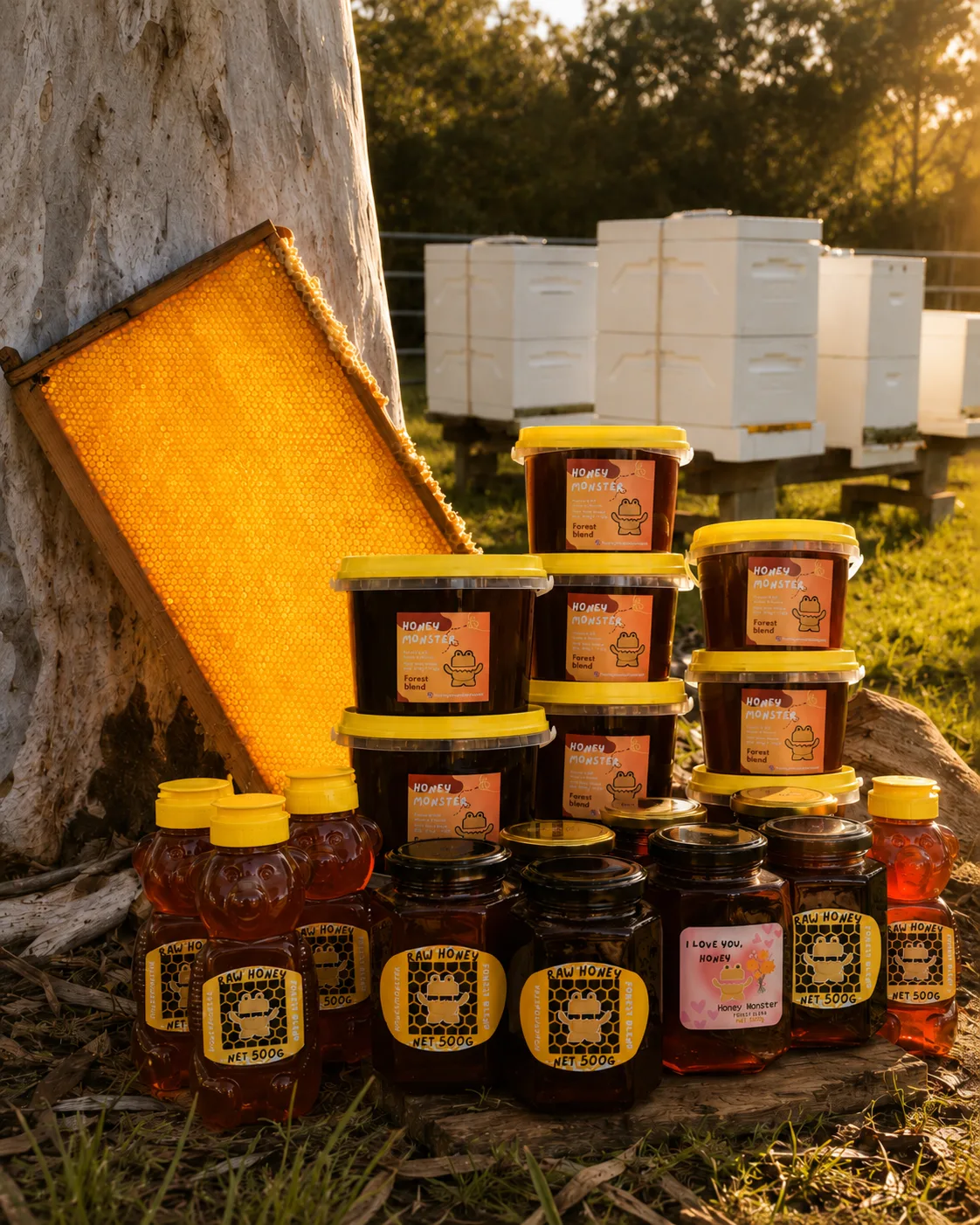
We keep around 40 hives in the Noosa hinterland, tucked among eucalypt, banksia, and whatever else is in flower through the year. The bees fly out, do the work, and come back.
We don't feed them sugar, we don't truck them around chasing crops, and we don't heat the honey. When a comb is fully capped we pull the frame, strain the wax out, and pour.
The honey leaves the hive at about 35°C and never gets any warmer. By the time it reaches your jar it's exactly as the bees made it.
What is raw honey?
Raw honey is honey that hasn't been heated above the temperature of the hive — around 35°C. Most supermarket honey is pasteurised at 60°C or higher to delay crystallisation and make it easier to bottle, but that heat damages the natural enzymes, breaks down the pollen, and changes how it tastes.
Ours skips all of that. We extract by spinning the capped frames, strain the wax through a coarse mesh to keep the pollen in, and pour straight into the jar. Nothing added, nothing removed.
Because the pollen is still in there, raw honey will crystallise over time — usually within a few months. That's a sign it's the real thing. If yours sets hard, stand the jar in warm water (not hot) for ten minutes and it'll loosen up again.
What the bees are working on
The Noosa hinterland is a long table of native eucalypt, banksia, melaleuca, and a rolling cast of seasonal natives. The flavour of every batch shifts with whatever's flowering — paler and lighter through spring when the eucalypts are running, darker and richer in autumn when the banksia and tea-tree take over.
We don't blend across the year to even it out. Each harvest is what the bees found that month, in that spot, on that day. Small differences from jar to jar are the point, not a problem.
We've kept bees here since 2021. The apiary runs around 40 hives, mostly clustered around Cooroibah — small enough that we can still check every box without rushing, big enough that we're a working sideliner rather than a backyard hobby. More hives would mean more honey but less time with each one, and the point is to know what's happening in every box before a frame is pulled.
We don't actually know what's in it.
Here's something genuinely strange: every jar of raw honey carries a record of where it came from. The pollen the bees pick up gets carried into the honey, and under a microscope it's a fingerprint. There's a whole science to reading it — melissopalynology — where a lab looks at the grains and tells you which plants the bees worked and roughly what part of the country they were standing in. It's how the pricey single-origin honeys prove they are what they claim.
We've never had ours tested. We look at what's in flower, we know the area, and we make a fair guess — but bees range a few kilometres in every direction and bring back whatever they please, so the honest answer is we don't know exactly what's in any given jar. Nobody followed them around.
And it's never just one thing. Two flows can land in the same hive in the same week — sometimes two different honeys in a single frame, side by side. The bees don't sort it and they don't label it. Every batch is a blend of whatever the hinterland was doing, mixed by the bees before we ever see it.
So that's the honest version of single-origin: every drop comes off our own hives, in one stretch of the Noosa hinterland — not that it's one flower, or the same jar twice. The bees blend the bush; we just don't blend the batches together to flatten out the difference. The record's still in there, pollen and all, because we strain rather than filter. We've simply never sent it off to be read. The bush keeps its own notes.
The boring-but-important bits
Honey Monster is a registered Queensland apiary. We're direct-to-consumer: we sell our raw honey from this site and hand-deliver locally. No wholesale, no supermarket shelf, no postage.
If you've got a question about a batch, how to store it, or whether we can do something custom for a gift, the contact form is the fastest way to reach us. We read every message.
Honey on bee time.